FIELD NOTES · NOV 2026
Capsule R-7 came home with 41 kilograms of crystal
A recovery morning in the desert: what was aboard, what the log says, and what happens to a boule next.
READ THE ENTRY →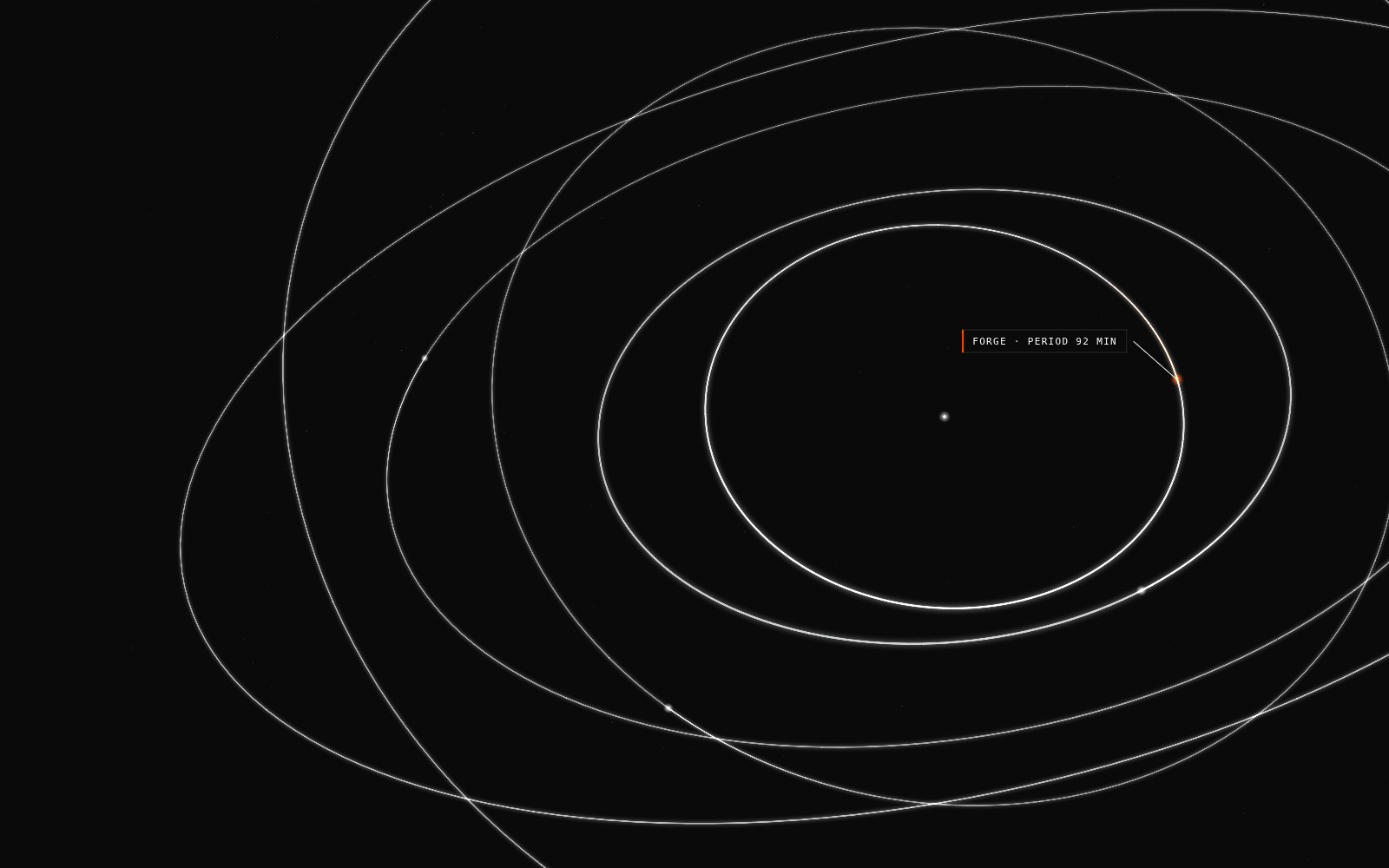
ANVIL-1 · ORBITAL MANUFACTURING STATION
Anvil Orbital grows alloys, crystals and machine parts in sustained microgravity aboard Anvil-1, then returns them to customers on Earth.
SPECIMEN — ANVIL-1, LIVE READINGS
STATION
Anvil-1 · 412 km
INCLINATION
51.6°
CREW
0 — fully robotic
POWER
84 kW · array + battery
MISSIONS — AN ORBIT TIMELINE
The first furnace module, launched on a rideshare and commissioned over 41 days. It has run alloy cycles continuously since — the orbit every other mission now shares.
2024 — IN SERVICE
PERIOD 92 MIN · BAY 1
A second bay fitted for protein and semiconductor crystal growth, where a still melt matters more than a hot one. First boule returned in March 2025, defect density below the terrestrial reference in the same run.
2025 — IN SERVICE
PERIOD 118 MIN · BAY 2
The logistics loop made regular: a capsule that leaves with feedstock and comes home with finished parts, on a published window every six weeks. R-7 landed at 06:40 UTC with 41 kg of crystal aboard.
2026 — IN SERVICE
CYCLE 42 DAYS · 60 KG DOWN
The keel of a second, larger station, assembled robotically from parts the first station made. A factory that builds its own successor is the whole argument of this company, in one mission.
2027 — IN ASSEMBLY
PERIOD 226 MIN · STRUCTURE
A contracted trial: high-purity feedstock refined on Anvil-1, transferred to a lunar-bound freighter. If the trial holds, the same cycle that serves Earth orbit serves the Moon.
2028 — PLANNED
PERIOD 641 MIN · TRANSFER
PERIODS ARE GROUND-TRACK REPEATS, READ OFF THE SAME CLOCK AS THE FIGURE ABOVE.
RETURNED MASS — CAPSULE R-7, RECOVERED AT FREMANTLE, 06:40 UTC
41 kg
Forty-one kilograms of grown, finished and inspected parts came home on R-7 — crystal, alloy and seal, each piece logged against the orbit that made it. The largest single return we have landed, and the first one a customer weighed before we did.
FIG. 12 — THE RETURN, WEIGHED ON RECOVERY · DEMO DATA
TECHNOLOGY — FOUR INSTRUMENTS
Three chambers holding 1,204 °C to within a degree for weeks at a time. Without convection, the melt is still — and stillness is the ingredient no ground furnace can sell.
No crew, no gloves, no exceptions: every transfer between furnace, inspection and capsule is done by two arms that work in vacuum and log every move to the gram.
Sixty kilograms down, every six weeks, on a window published a year ahead. The capsule is the product's front door: what grows up there has to survive coming home.
The station schedules itself — thermal, power, traffic — on compute built to shrug off the radiation environment, with a ground veto on every consequential decision.
PROCESS — THE MANUFACTURING CYCLE
01
Feedstock flies as dense, dumb mass — the cheapest cargo there is. Nothing fragile goes up; everything fragile is made up there.
02
The cycle runs for days or weeks in a still melt. Temperature, vibration and orientation are logged continuously, and the log ships with the part.
03
Cutting, polishing and inspection happen on orbit, where a part's weight costs nothing to hold. What fails inspection is re-melted, not returned.
04
Finished parts ride the next capsule down and are in the customer's lab within days — with the full cycle log as their certificate.
MEASUREMENTS — CAPABILITY, COUNTED
| Measurement | On Anvil-1 | Terrestrial reference | Method |
|---|---|---|---|
| Crystal defect density | 38× fewer | — | Same boule, split run, etched and counted blind |
| Alloy grain uniformity | ±2.1% | ±9.4% | Cross-section microscopy, 40 samples per cycle |
| Furnace uptime, trailing year | 99.2% | — | Station log, unplanned stops only |
| Return mass per capsule | 60 kg | — | Capsule R-7 manifest, weighed on recovery |
| Feedstock-to-part cycle | 19 days | 26 days | Median of the last 12 production cycles |
DEMO DATA
PARTNERS — NAMED, NOT BADGED
Helios Launch Consortium
RIDESHARE · TWO FLIGHTS A YEAR
Kestrel Materials Group
FEEDSTOCK · ALLOYS & PRECURSORS
Northfield University — Orbital Laboratory
RESEARCH · CRYSTAL CHARACTERISATION
Port of Returns, Fremantle
RECOVERY · CAPSULE LOGISTICS
CAREERS — THE GROUND CREW
Flight Dynamics Engineer
ZÜRICH · RENDEZVOUS & DOCKING
Furnace Operator, Night Cycle
REMOTE OPS · ROTATING WATCH
Return Logistics Lead
FREMANTLE · CAPSULE RECOVERY
NEWS — FROM THE FLIGHT LOG
FIELD NOTES · NOV 2026
A recovery morning in the desert: what was aboard, what the log says, and what happens to a boule next.
READ THE ENTRY →ENGINEERING · NOV 2026
The second station’s keel held 2.4 bar differential for 72 hours — the longest ground test we have run, and the gate for the 2027 launch window.
READ THE ENTRY →OPERATIONS · OCT 2026
Ninety minutes from splashdown to weighed and logged. The recovery crew walks through the morning R-7 came home.
READ THE ENTRY →QUESTIONS — ASKED AT THE BRIEFING